All Care Guides

Peperomia obtusifolia vs Pothos: Toxicity, Morphology & Care Compared

2026-05-03
Updated: 2026-05-14
Elena Rodriguez

Peperomia obtusifolia (Piperaceae, pepper family) and Pothos (Epipremnum aureum, Araceae, aroid family) are unrelated species with inverted toxicity profiles and inverted growth habits. Pothos contains calcium-oxalate raphides — needle-shaped crystals stored in specialised idioblast cells that fire into oral tissue when the leaf is chewed, causing the species' ASPCA classification as toxic to cats and dogs. Peperomia obtusifolia contains no raphides and is ASPCA non-toxic. Pothos is a fast trailing/climbing vine (30–90 cm annual growth, aerial roots at every node, tolerates continuous moist substrate). P. obtusifolia is a slow upright semi-succulent (2–5 cm annual growth, no aerial roots, requires top 2–3 cm dry between waterings). The two species are routinely sold side-by-side as "easy beginner plants" — but for pet households, the choice is not aesthetic. Misidentification has welfare consequences.

The standard "easy beginner plant" framing that lumps Peperomia obtusifolia and Pothos together is not entirely wrong — both species tolerate the range of light, temperature, and humidity conditions present in most indoor environments better than the average tropical houseplant. The problem is the framing obscures the parameter where the two species diverge most sharply: toxicity. A household with curious chewing pets is making a categorically different decision than a household without, and the "they're both easy" framing offers no signal to that difference.

ParameterPeperomia obtusifoliaPothos (Epipremnum aureum)
FamilyPiperaceaeAraceae
OrderPiperalesAlismatales
Native rangeNeotropical understoreyMo'orea (French Polynesia), now pantropical
HabitUpright semi-succulentTrailing/climbing vine
Leaf shapeBroadly oval (obovate), rounded tipHeart-shaped (cordate), pointed tip
Stem textureThick, rigid, semi-succulentThin, flexible, green
Aerial rootsNoneAt every node
Pet toxicityNon-toxic (ASPCA)Toxic — calcium-oxalate raphides (ASPCA)
Growth rate2–5 cm/year30–90 cm/year
Watering triggerTop 2–3 cm fully dryTop 50% dry
Saturation tolerance<5 days continuous14+ days continuous
Light optimum2,000–4,000 lux800–2,500 lux (lower-light tolerant)
Propagation success80–95% stem cuttings90–98% node cuttings
Mature size (indoor)20–30 cm tall1.5–3 m trailing

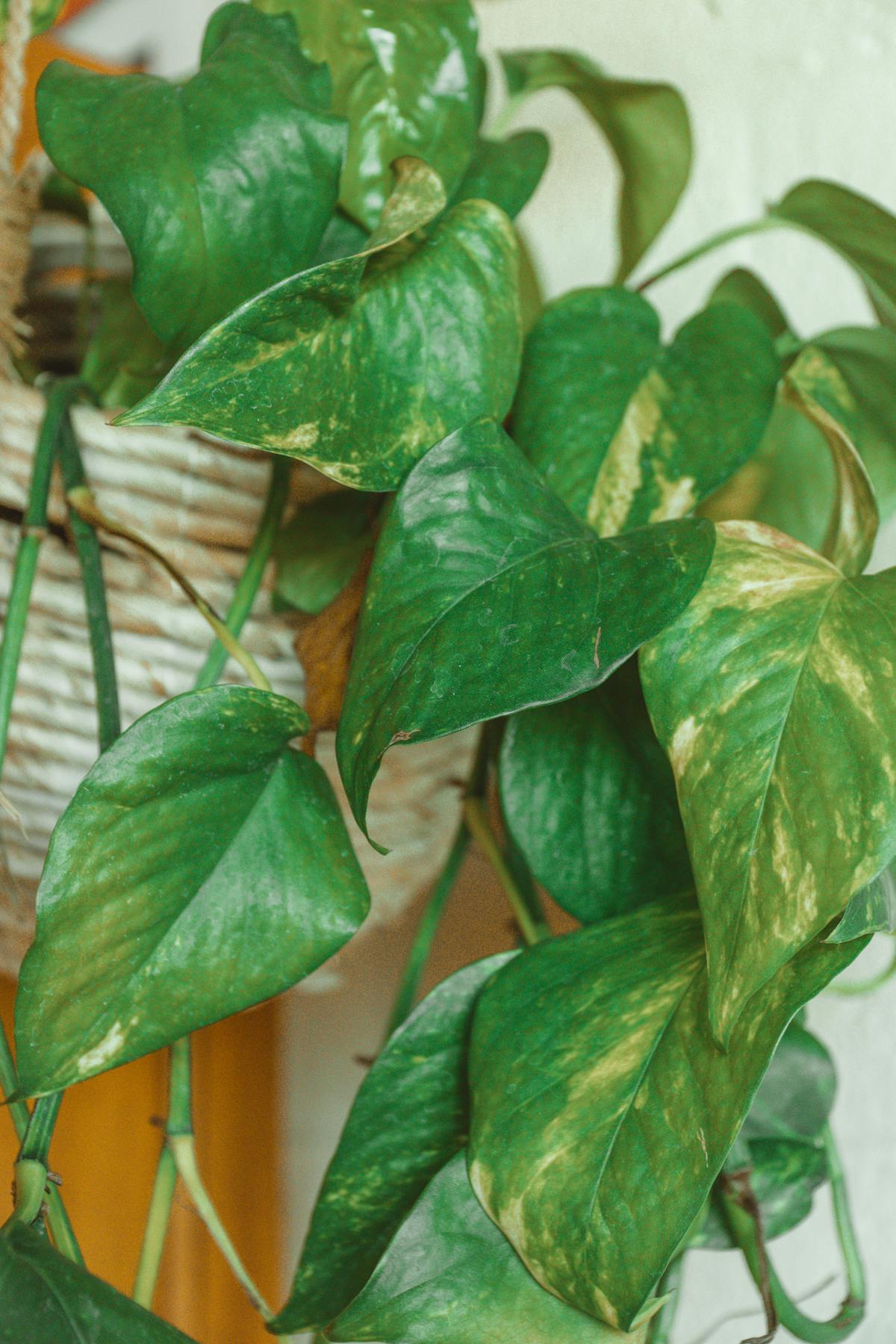
Lush trailing Pothos cascading from a wicker basket — the vining morphology that distinguishes Pothos from the upright Peperomia obtusifolia

1. The Toxicity Divide — Raphides vs No Defensive Chemistry

The single most consequential difference between the two species is in the chemical defence each produces. The mechanism is well-documented in plant pathology and is the basis for both species' ASPCA listings.

Pothos and the raphide defence. Pothos leaves and stems contain specialised cells called idioblasts that house bundles of microscopic needle-shaped crystals — raphides — composed of calcium oxalate monohydrate. The crystals are 50–200 μm long, sharply pointed at both ends, and arranged in tight parallel bundles within the idioblast. When the surrounding tissue is mechanically disrupted by chewing, the bundles eject the raphides at high velocity into the soft tissue of the mouth, tongue, and throat. The mechanism is documented in detail in the Wikipedia raphide article. The biological effect on a chewing cat or dog is immediate intense oral irritation, drooling, swelling of the mucous membranes, vomiting, and in severe cases difficulty swallowing or breathing if oedema reaches the airway. The ASPCA classifies Epipremnum aureum as toxic to cats, dogs, and horses on this basis.

Peperomia obtusifolia and the absence of raphides. The Piperaceae family has not evolved raphide-based chemical defence. P. obtusifolia tissue contains no idioblast cells, no calcium-oxalate crystals, and no comparable chemical irritants. The species' internal fluids are biologically inert to mammalian tissue. The ASPCA listing — verified at the canonical entry — confirms the species as non-toxic to cats, dogs, and horses. The defensive strategy P. obtusifolia does deploy is mechanical: a thick waxy cuticle that is structurally difficult to puncture, and thick semi-succulent leaves that resist chewing through bulk rather than chemistry. A pet that bites a P. obtusifolia leaf finds it unappealing texturally but suffers no chemical injury.

The procedural implication is direct: in a household with cats or dogs that chew houseplants, the species choice between Peperomia obtusifolia and Pothos is not aesthetic — it is a safety decision. Pothos placed within reach of a chewing pet is a documented hazard; Peperomia in the same position is not.

2. Taxonomic Divergence — Different Families, Different Orders

The two species belong not just to different families but to different monocot orders.

Peperomia obtusifolia: Order Piperales → Family Piperaceae → Genus Peperomia. The family also contains the culinary pepper genus Piper (Piper nigrum — black pepper; Piper methysticum — kava). All ~3,600 Piperaceae species share the characteristic scattered vascular bundles, paripinnate venation, and absence of calcium-oxalate raphides that distinguish the family.

Epipremnum aureum (Pothos): Order Alismatales → Family Araceae → Genus Epipremnum. The aroid family contains some 3,750 species including Monstera, Philodendron, Anthurium, Spathiphyllum (peace lily), Caladium, and Dieffenbachia — most of which share the raphide-containing idioblast morphology and the corresponding pet toxicity. The Wikipedia Epipremnum aureum entry documents the species' native range (Mo'orea, French Polynesia) and pantropical naturalised distribution.

The two orders — Piperales and Alismatales — diverged at the base of the monocot lineage and share no recent common ancestor. The two species look superficially similar (tropical, green-leaved, glossy) because both adapted to tropical understorey conditions, not because they are related.

3. Morphology — How to Distinguish Them at a Glance

Four physical traits separate the two species with high reliability:

Stem direction and habit. P. obtusifolia produces multiple upright stems from a basal crown, with the canopy held above the substrate at 20–30 cm. Pothos produces a primary stem that trails downward over the pot rim or climbs upward when given a support. A specimen growing horizontally over the pot rim is Pothos; a specimen growing vertically from the substrate is P. obtusifolia.

Leaf morphology. P. obtusifolia leaves are obovate — broadly oval with a rounded tip, narrowing slightly toward the petiole, glossy and thick, typically 4–12 cm long. Pothos leaves are cordate — heart-shaped with a pointed tip and a distinct notch where the leaf meets the petiole, thinner and more flexible, typically 8–15 cm long indoors (much larger when mature on a climbing support). The difference is unambiguous on visual inspection.

Stem texture. P. obtusifolia has thick, rigid, semi-succulent stems that resist bending — visible internodes every 2–3 cm with discrete nodes. Pothos has thin, flexible, predominantly herbaceous stems that can be wrapped around a finger without breaking, with nodes every 5–10 cm.

Aerial roots. Pothos produces visible adventitious aerial roots at every node — small brown protrusions that emerge from the stem at each leaf attachment point, used in nature to climb tree bark via thigmotropic anchoring. P. obtusifolia produces no aerial roots; its root system is entirely subterranean and confined to the pot substrate.

Any one of these traits distinguishes the two species. The aerial-roots test is the most rapid: a careful look at a single node of the stem either reveals the brown protrusions of Pothos or the smooth nodes of P. obtusifolia.

Trailing Pothos vine against a sunlit white wall — the cascading vining habit that requires a hanging basket or climbing support, distinct from the upright Peperomia obtusifolia profile

4. Growth Rate and Operational Care Differences

The growth rates are not subtle. The implications for pot size, pruning frequency, and display geometry are correspondingly large.

P. obtusifolia grows 2–5 cm per year. A specimen purchased at 20 cm reaches its mature 25–30 cm height after 1–3 years and then effectively stops vertical extension. Pot upsizes happen at most every 2–3 years (see the root-bound guide for the hydraulic threshold that triggers repotting). Pruning is needed only to remove damaged stems or to take cuttings.

Pothos grows 30–90 cm per year indoors. A specimen purchased at 30 cm trailing reaches 1.5–3 m within 2 years if unpruned. Pot upsizes are needed every 1–2 years. Pruning is a routine and frequent operation — most owners trim Pothos quarterly to maintain a manageable form, propagating the trimmed cuttings in water (Pothos roots in water at >95% success rate within 7–14 days).

The watering, light, and humidity ranges differ correspondingly. Pothos tolerates moist substrate with the top 50% drying between waterings, accepts saturation for 14+ days without immediate distress, and grows actively at lower light (down to 800–1,500 lux) where Peperomia would etiolate. P. obtusifolia requires the top 2–3 cm fully dry between waterings, suffers root anoxia within <5 days continuous saturation, and operates optimally at 2,000–4,000 lux — see the canonical care thresholds for the full range. Applying Pothos watering frequency to P. obtusifolia is the standard pathway to root rot on misidentified specimens.

5. Why the "Lumping" Is Wrong — The Welfare-Consequence Position

This is the section the standard "Peperomia vs Pothos — both are easy beginner plants" article omits. The site's editorial position, stated without softening: the lumping of these two species under the "easy beginner plant" label is the practical equivalent of treating Peperomia obtusifolia and Ficus elastica as interchangeable. The Pothos toxicity classification is not a footnote — it is the primary operational parameter for any household with chewing pets.

The three downstream errors that the lumping produces:

  1. Misidentification at the nursery. A grower who walks into a nursery looking for "an easy trailing houseplant" and receives a Pothos — without being warned about the toxicity — has not made an informed choice. The four-trait identification test (stem direction, leaf shape, stem texture, aerial roots) is the corrective.
  2. Misapplied care advice. A grower who watered a Pothos successfully and applies the same schedule to a Peperomia obtusifolia produces predictable root anoxia within 1–2 weeks. The species' tolerated-moisture ranges do not overlap.
  3. Pot displays that mix the two. Owners who plant both species in the same pot find within a season that Pothos has out-competed the Peperomia for both light and water. The two species cannot share substrate at the same care schedule.

The corrective is the diagnostic differentiation in Section 3 and the explicit toxicity disclosure in Section 1, both applied at point of purchase rather than after the fact.

6. Which Species Suits Which Household

The decision is conditional. There is no general winner.

Choose Pothos when:

  • The household has no chewing pets, or all houseplants are placed above pet-reachable height.
  • The grower wants visible rapid growth and tolerates frequent pruning.
  • The display geometry calls for a trailing or climbing form — hanging baskets, shelf overhangs, moss-pole columns.
  • The light position is limited (lower than 2,000 lux) and Peperomia would etiolate.

Choose Peperomia obtusifolia when:

  • The household has cats, dogs, or other curious chewing animals at floor level — see the pet-safety guide for the comparative non-toxic listing.
  • The grower wants a stable, structurally upright specimen that maintains a consistent silhouette for years.
  • The watering schedule will be intermittent (travel, inconsistent monitoring) — the species tolerates underwatering far better than overwatering.
  • The display position has 2,000+ lux of bright filtered light available.

Both species are tolerant of beginner-level care; both will survive the standard indoor conditions of most rooms. The decision criteria above are the ones that distinguish a thriving specimen from a struggling one.

Pothos vine showing characteristic heart-shaped leaves and trailing growth habit — the morphological signature that distinguishes Epipremnum aureum from Peperomia obtusifolia

7. Comparative Care Reference

For the household running both species in the same room — common because the two species do tolerate similar light and temperature ranges — the operating differences condense into this reference table.

Care parameterPeperomia obtusifoliaPothos
Light range2,000–4,000 lux800–2,500 lux
Light tolerance (low)Tolerated minimum 800 luxTolerates 400 lux briefly
Light tolerance (high)<40,000 lux unfiltered<40,000 lux unfiltered
Temperature optimum18–24 °C18–27 °C
RH optimum40–60%40–60%
RH toleranceDown to 30% brieflyDown to 30% sustained
Watering frequency (12 cm pot, summer)Every 10–14 daysEvery 5–7 days
Substrate type50% coir / 30% perlite / 20% barkStandard aroid mix
Pot size upgrade interval2–3 years12–18 months
Fertiliser strengthBalanced NPK at 50% rateBalanced NPK at full rate
Fertiliser frequencyMonthly spring–summerFortnightly spring–summer
Propagation methodStem or leaf cuttingsSingle-node water cuttings
Propagation success rate80–95% (stem)95–98%
Time to first roots14–28 days7–14 days
Recommended pot12–15 cm terracottaHanging basket or 15–20 cm plastic
Recommended fertiliser50% NPK 20-20-20Same product, full strength

The shared columns — temperature, humidity, fertiliser type — are why the two species often share a windowsill successfully. The diverging columns — watering frequency, pot size cadence, fertiliser strength, propagation interval — are where the care must be split.

Conclusion

Peperomia obtusifolia and Pothos are unrelated species (Piperaceae vs Araceae, two different monocot orders) with inverted growth habits and inverted toxicity profiles. Pothos is a fast trailing vine containing calcium-oxalate raphides — toxic to cats and dogs per ASPCA. Peperomia obtusifolia is a slow upright semi-succulent containing no raphides and ASPCA non-toxic. The two are routinely sold under the same "easy beginner plant" framing, but the framing obscures the toxicity divergence that is the dominant practical parameter for pet households. Distinguishing the two species at the nursery is straightforward via four physical traits (stem direction, leaf shape, stem texture, aerial roots) and takes less than 60 seconds. The decision between them is conditional on pet exposure, light position, growth-rate preference, and watering consistency — not on a generic "which is easier" question.

Related comparison and identification resources:

Care FAQ

What is the main difference between Peperomia obtusifolia and Pothos?

Three operationally important differences. (1) Toxicity: Pothos (Epipremnum aureum) contains calcium-oxalate raphides — needle-shaped crystals classified by the ASPCA as toxic to cats and dogs. Peperomia obtusifolia is ASPCA non-toxic. (2) Growth habit: Pothos is a trailing/climbing vine that grows 30–90 cm per year and produces aerial roots at every node. P. obtusifolia is an upright semi-succulent that grows 2–5 cm per year and produces no aerial roots. (3) Watering: Pothos tolerates moist substrate with the top 50% drying between waterings; P. obtusifolia requires the top 2–3 cm fully dry and is intolerant of continuous moisture. The species are not interchangeable in pet households or in mixed-care pot displays.

Is Peperomia obtusifolia safer than Pothos for cats and dogs?

Yes, significantly. Pothos leaves contain bundles of calcium-oxalate raphides — microscopic needle-shaped crystals stored in idioblast cells that fire into oral tissue when chewed. According to the ASPCA Pothos listing, ingestion causes oral irritation, intense burning of the mouth, drooling, vomiting, and difficulty swallowing in cats and dogs. Peperomia obtusifolia contains no raphides and is listed as non-toxic to cats, dogs, and horses (ASPCA). For households with curious chewing pets, the toxicity difference is the dominant practical consideration — aesthetic preference is secondary.

How do you tell Peperomia obtusifolia and Pothos apart at the nursery?

Four reliable diagnostic differences. (1) Stem direction: Pothos trails or climbs from a central crown; P. obtusifolia grows upright with multiple stems from the base. (2) Leaf shape: Pothos leaves are heart-shaped (cordate) with a pointed tip; P. obtusifolia leaves are broadly oval (obovate) with a rounded tip. (3) Stem texture: Pothos has thin flexible green stems that you can wrap around a finger; P. obtusifolia has thick rigid semi-succulent stems with visible nodes every 2–3 cm. (4) Node anatomy: Pothos produces visible brown aerial roots at every node; P. obtusifolia produces none. Any one of these distinguishes the two species without ambiguity.

Are Peperomia and Pothos related botanically?

No. Peperomia obtusifolia belongs to Piperaceae (the pepper family, order Piperales); Epipremnum aureum belongs to Araceae (the aroid family, order Alismatales). The two families belong to entirely different monocot lineages and share no recent common ancestor. The visual similarity — both are tropical green-leaved houseplants — is taxonomic coincidence, not relatedness. The species cannot interbreed and do not share care requirements at any operating parameter.

Can I grow Peperomia obtusifolia and Pothos in the same pot?

Technically possible, operationally inadvisable. Pothos grows 10–30× faster than P. obtusifolia and will out-compete it for light within a single season. Pothos also tolerates substrate moisture levels that are pathological for P. obtusifolia — a watering schedule matched to the Pothos produces root anoxia in the Peperomia within 1–2 weeks. If both species must share a display, use separate pots within the same cachepot or grouping; do not share substrate.

Which one is easier to care for?

Both are commonly described as "easy beginner plants" and both genuinely tolerate a range of indoor conditions, but the failure modes differ. Pothos is more forgiving of overwatering and inconsistent light; its primary failure mode is rapid growth that the grower cannot match with pot size or pruning. P. obtusifolia is more forgiving of underwatering and consistent neglect; its primary failure mode is overwatering — applying generic houseplant-care advice (which is calibrated to faster-growing aroids like Pothos) produces root anoxia within 5–10 days. For a household that travels and waters inconsistently, Peperomia is more forgiving. For a household that wants visible rapid growth, Pothos is more rewarding.

Can Peperomia obtusifolia trail like a Pothos?

No — the growth habit is fundamentally different. P. obtusifolia has an upright semi-succulent stem with scattered vascular bundles and produces no aerial roots; it cannot climb or trail in the way that Pothos does. Mature specimens may have slightly drooping outer stems under their own weight, particularly in low-light conditions where etiolation elongates the internodes, but this is structural sag, not vining. For a true trailing Peperomia, P. prostrata (string of turtles) or P. rotundifolia are the species that match the morphology — not P. obtusifolia.

Elena Rodriguez

About Elena Rodriguez

Elena Rodriguez is an interior landscaping designer who specializes in integrating live plants into modern home environments. She focuses on plant aesthetics, placement, and bioactive vivariums.