All Care Guides

Stem Rot on Peperomia obtusifolia: Pathogenesis, Causes & Rescue

2026-05-03
Updated: 2026-05-14
Marcus Thorne

Stem rot on Peperomia obtusifolia is a vascular infection by Pythium and Phytophthora oomycetes (water moulds) that dissolves cell walls via pectinases and cellulases, producing soft mushy black tissue that advances along the stem at 1–5 cm per day under warm humid stagnant-air conditions. The rescue is exclusively surgical: a sterile cut 2 cm above the highest visible discolouration, with cross-section inspection confirming 100% clean tissue, after which the cutting is calloused for 48 hours and re-rooted as a fresh propagation. The contaminated substrate is discarded — oomycete spores persist in dry soil for months. Fungicide does not reverse established infection. The four converging causes (substrate anoxia, root leakage, mechanical or thermal entry point, low transpiration) must all be addressed in the recovery setup to prevent recurrence.

The standard houseplant-advice treatment of stem rot — "let it dry out, repot, treat with fungicide" — describes a recoverable root-zone problem, not stem rot. Once the vascular tissue itself is colonised, the affected stem segment is structurally dissolved and cannot be re-greened. The diagnostic distinction matters. Root rot is recoverable through repotting and pruning the affected roots; stem rot requires amputation of the affected stem and rescue of an unaffected cutting. Mistaking one for the other is the most common reason a stem-rot specimen continues to decline after the recommended intervention.

SignWhat it indicatesImplication
Stem darkening at baseActive oomycete infection at substrate-stem interfaceBegin rescue immediately
Mushy stem texture (deforms under finger pressure)Cell-wall dissolution complete in that segmentTissue is lost; cut above
Sour or fermented smellAnaerobic substrate + pathogen activitySubstrate is a biohazard
Brown vascular ring in cut cross-sectionInternal infection beyond visible surfaceCut higher
Lower leaves yellow then drop, upper leaves wiltVascular occlusion — water cannot riseConfirms stem-internal infection
Black advance >1 cm per dayActive progression under favourable conditionsQuarantine, lower humidity, accelerate rescue

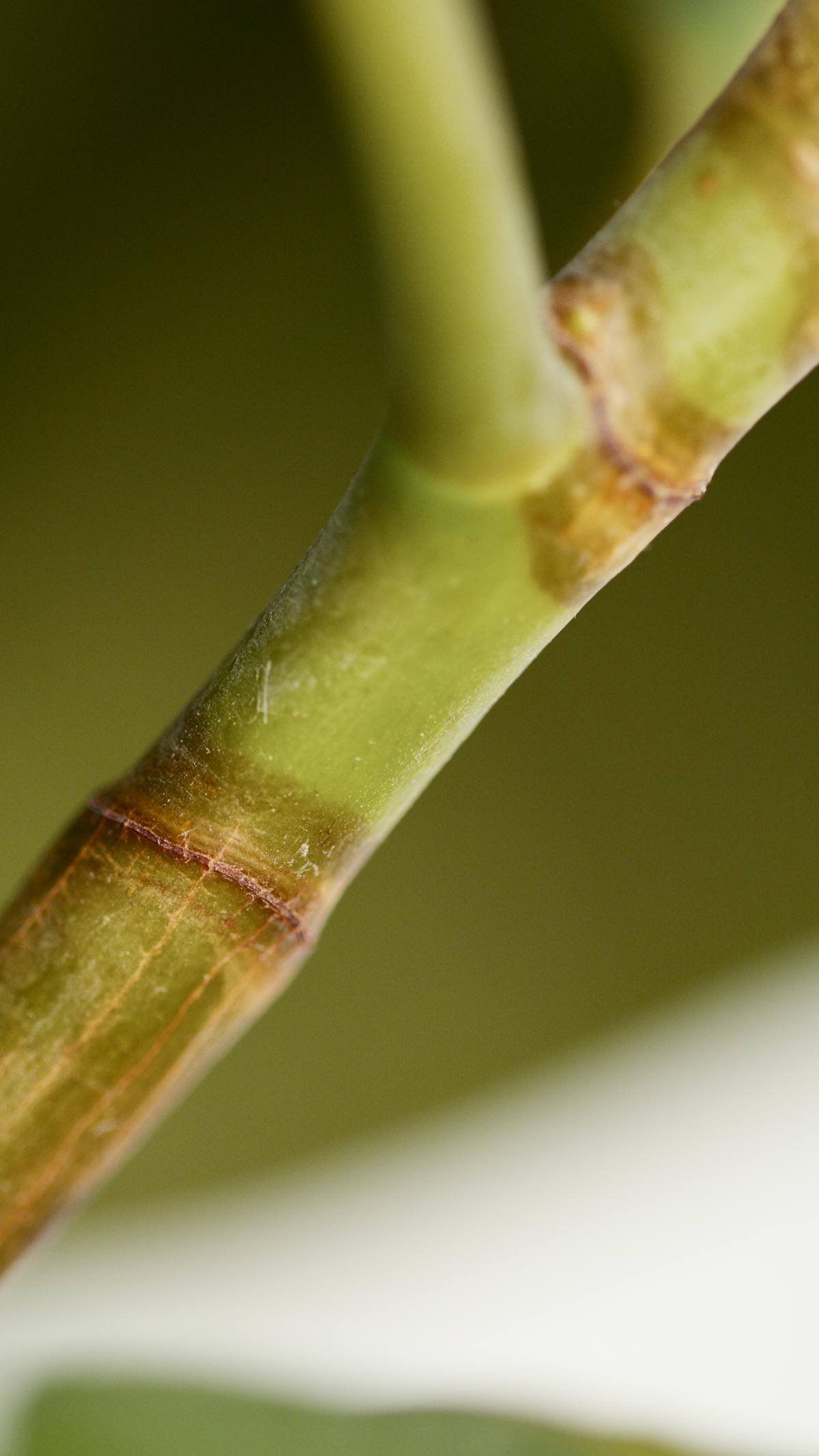
Close-up of a healthy green plant stem and node — the structural unit that stem rot dismantles when infection takes hold

1. The Pathogens — Pythium, Phytophthora, and the Enzymatic Attack

Stem rot on Peperomia obtusifolia is overwhelmingly caused by oomycetes — water moulds belonging to Pythium and Phytophthora. These organisms are filamentous and visually fungus-like but belong to a different kingdom entirely (Stramenopiles, not Fungi), which is why ordinary fungicides have little effect on them. They reproduce by motile zoospores that swim through films of water on the substrate and stem surface; the species is well-documented in plant pathology, including the Wikipedia oomycete article.

The cellular attack is mechanistic and predictable:

Step 1 — Adhesion. A swimming zoospore encounters the stem surface, encysts, and germinates a hypha. On a healthy waxy cuticle the hypha cannot penetrate; on tissue with mechanical damage, thermal microfracture, or chemical compromise, the hypha enters the cortex within hours.

Step 2 — Pectinase release. The advancing hypha secretes pectinases — enzymes that hydrolyse pectin, the polysaccharide that cements adjacent plant cells together. The cells lose their structural connection. This is the cellular basis of the soft, mushy texture: not water-logging but enzymatic separation of cells from each other.

Step 3 — Cellulase release. Once intercellular pectin is dissolved, cellulases break down cellulose — the fibre that forms the cell wall itself. Individual cell walls collapse. Cytoplasm and vacuolar contents leak into the intercellular spaces.

Step 4 — Phenolic oxidation. Dying cells release stored phenolic compounds as a final defence. These react with atmospheric oxygen and with the pathogen's own enzymes to form melanin-like polymers — the black or dark-brown colour of the rot front. The blackening is not the rot itself; it is the plant's failed last-line response visible at the cellular interface.

Step 5 — Vascular colonisation. The hypha enters the xylem vessels and exploits the plant's transpirational stream for vertical dispersal. Pathogen movement upward through xylem is approximately 2–4 cm ahead of the visible blackening front — the reason a surgical cut just above the visible discolouration almost always reveals contaminated tissue and fails to save the cutting.

2. The Four Converging Causes — Why Stem Rot Happens

Stem rot is rarely the result of a single error. It requires the simultaneous presence of four conditions that overcome the species' substantial native resistance to oomycete infection. The site's editorial position: stem rot is the convergence — fix any three, the fourth rarely produces infection alone.

Cause 1 — Substrate anoxia. Continuous wet substrate, peat-heavy compaction, or pot drainage failure suppresses root respiration. The roots cannot respire aerobically and begin to leak organic acids, sugars, and electrolytes into the rhizosphere. This leakage is the chemical signal that attracts oomycete zoospores from any spore reservoir in the substrate. Correction: a free-draining substrate (≥30% perlite by volume), bottom-watering with periodic top-flush, and the dry-down rule (top 2–3 cm fully dry before re-watering).

Cause 2 — A mechanical or thermal entry point. A healthy waxy cuticle on P. obtusifolia is mechanically and chemically resistant to oomycete penetration. The infection enters through compromise: a wound from rough handling, a thermal microfracture from cold-water irrigation (<15 °C against a 22 °C ambient produces visible cell-membrane contraction within seconds), or chemical damage from sustained leaf-axil water in low-airflow rooms. Correction: room-temperature water (18–24 °C), no misting that leaves standing water in leaf axils, and physical care during repotting.

Cause 3 — Low transpiration. Calcium is phloem-immobile — it moves through the plant only in the transpiration stream. In low-VPD conditions (high humidity + low airflow + cool temperature), transpiration slows and calcium fails to reach new cell walls. The new tissue forms with weak pectin-calcium crosslinks and provides minimal resistance to pectinase attack. Correction: airflow management (gentle fan, open window), VPD in the operating range (40–60% RH at 18–24 °C), avoiding the >75% RH stagnant-air condition that is the textbook risk threshold from the site humidity guide.

Cause 4 — Spore reservoir. Oomycete spores are not rare. They arrive on new nursery plants, in bagged compost stored damp, in irrigation water that has contacted infected material. A clean indoor environment with no spore source rarely develops stem rot regardless of the other three conditions. Correction: 21-day quarantine of new plants, fresh sealed bagged compost, separate watering containers per pot, and discard of any contaminated substrate.

The four-condition framework is also the predictive tool: a P. obtusifolia on free-draining substrate, watered with room-temperature water, in a 50% RH room with airflow, on its own watering routine — is at very low risk regardless of how many oomycete spores may be in the environment.

Detailed macro shot of a leaf showing tissue damage and visible vein patterns — the cellular structure that pathogen enzymes attack

3. Diagnosis — Stem Rot vs Root Rot vs Mechanical Damage

The three failure modes look similar from the leaf canopy. The diagnostic differentiation happens at the substrate and the stem cross-section.

ConditionVisible signsSubstrate testCross-sectionSalvage
Stem rotBlack/brown advancing front on stem; mushy textureWet, possibly sourBrown vascular ringsCutting above the rot
Root rotLower leaves yellow then wilt; substrate wetBlack soft roots, sour smellStem may still be cleanRepot with root pruning
Mechanical damageLocalised bruise or break; no advanceSubstrate condition is irrelevantClean tissue around woundPruning to clean tissue
Bacterial soft rotWater-soaked translucent zones; rapid spreadOften wetFoul-smelling slimeAggressive cutting; often fatal

The procedural sequence on any specimen with a softening or discolouring stem:

  1. Smell test at the substrate. A sour or fermented smell indicates anaerobic root or stem-base activity. Without this, the cause is more likely mechanical.
  2. Pot weight and substrate touch. A heavy pot with wet substrate suggests an ongoing watering problem; a dry pot rules out the substrate-anoxia cause and points to mechanical, thermal, or bacterial origin.
  3. Stem cross-section. Cut just above the visible discolouration. Photograph the cross-section. A uniform white-to-cream interior is healthy. Brown rings, brown specks in the vascular bundle, or general discolouration of the central tissue all indicate active infection beyond the visible surface.
  4. Root inspection. If the cross-section is clean but the lower stem is dark, unpot and inspect roots — black soft roots indicate the problem is root rot reaching upward, and the recovery is repotting with root pruning rather than stem cutting.

A failure to distinguish stem rot from root rot is the most common reason an "I cut the rot off and it came back" outcome occurs. The cut may have been above the visible darkening but below the internal vascular infection.

4. The Surgical Rescue Protocol

The plant is not rescued. A cutting from above the infection zone is rescued. This is the procedural rule that recovers the genetic material when no other intervention works.

Tools. A pair of stainless-steel pruning shears or a sterile single-edge blade. Sterilise the cutting edge with 70% isopropyl alcohol immediately before each cut and between cuts on the same plant.

Step 1 — Quarantine. Move the affected plant to a separate location at least 1 m from healthy specimens. The zoospores are mobile in any water film, and adjacent pots are at immediate risk.

Step 2 — Identify the cut height. Locate the highest visible point of discolouration on the stem. Measure 2 cm above this — the procedural clearance distance based on the typical 2–4 cm internal lead of vascular infection. Mark the cut line.

Step 3 — First cut. Make a clean horizontal cut at the marked height with the sterilised blade. Examine the cross-section immediately under good light. The interior must be uniformly white to pale green — no brown rings, no brown specks, no discolouration in the central tissue.

Step 4 — Iterate if necessary. If any discolouration is present in the cross-section, the cut was through infected tissue. Re-sterilise the blade. Cut 1–2 cm higher. Re-inspect. Repeat until the cross-section is 100% clean. A cutting taken from clean tissue at any height above the infection is preferable to a longer cutting that contains hidden infection.

Step 5 — Callous. Set the cutting on a paper towel in still indoor air at 18–24 °C. Allow the cut surface to dry and form suberin — the wax-impregnated tissue that seals the wound — for 48 hours. Do not dust with cinnamon or any folk-remedy substance; the callous is what blocks pathogen re-entry, not topical applications.

Step 6 — Re-root. Pot the cutting into fresh substrate (never the original infected substrate) or into pre-soaked LECA. Standard stem cutting propagation protocol applies — 14–28 days to first roots in water, 21–42 days in perlite/pumice, at 80–95% success rate for clean cuttings.

Step 7 — Discard. The original root system, the original stem below the cut, the original substrate, and the original pot contents go to outdoor refuse — sealed in a plastic bag, not composted. Wash the pot with a 10% bleach solution and rinse before re-use. Sterilise all tools with 70% isopropyl alcohol.

Close-up of a thick plant stem on a dark background — the kind of stem cross-section to inspect for vascular discolouration during the rescue cut

5. Why Standard Stem-Rot Advice Fails

The standard houseplant-care response to a softening stem — "let the substrate dry out, water less, repot, perhaps a fungicide drench" — is the response to root rot, not stem rot. The procedural error is the same one opinions.md identifies as the strongest editorial signal on the site: do not "rescue" a wilted plant by watering immediately, and do not assume drying out reverses an active vascular infection. The wilt on a stem-rot plant is caused by vascular occlusion — the xylem is mechanically blocked by pathogen hyphae and cell debris — not by water shortage. Allowing the substrate to dry does nothing to clear the occluded xylem, and the affected stem continues to advance regardless of substrate moisture.

The mistake compounds in three predictable ways:

  • The "wait and see" delay. Each 24-hour delay at 22–25 °C and >70% RH allows the rot front to advance 1–5 cm. A waited rescue is typically a higher cut, more lost tissue, and a smaller surviving cutting.
  • The "more fungicide" instinct. Surface-applied fungicide on visible blackening does not reach the active hyphae inside the vascular bundle. The exception is phosphonate-based prophylaxis on adjacent plants — a useful preventive measure, not a treatment for the diagnosed specimen.
  • The "repot into fresh soil" assumption. Repotting an infected plant into fresh substrate transfers the infection to fresh substrate. Without surgical removal of the affected stem, the new substrate becomes contaminated within days.

The fix is procedural, not substantive: diagnose first, cut second, discard third. The cutting is what survives.

6. The Diagnostic Pattern — Recurring Reader Correspondence

A frequent diagnostic scenario in correspondence on this site: a reader reports leaf yellowing beginning at the lower whorl and progressing upward, substrate moist or wet on inspection, and a plant that has been watered weekly on a fixed schedule for several months. Examination reveals soft brown roots, a sour-smelling substrate, and — once the substrate is wiped from the stem base — a softening dark band at the substrate-stem interface that the leaf damage had hidden.

This is the convergence pattern: schedule-watering caused continuous saturation; root respiration failed within 5 days; Pythium colonised the anoxic roots; the lower stem became the vascular conduit by which the pathogen advanced into the canopy. The lower-leaf yellowing is mobile-nutrient remobilisation as the plant scavenges nitrogen and magnesium from older tissue to support upper foliage. Wilting in wet substrate — the diagnostic key — confirms the pathology over simple under-watering.

The intervention sequence is unchanged from the rescue protocol: quarantine, surgical cut into clean tissue, callous, re-root the cutting, discard the substrate. Adding water to a wilting-in-wet-substrate plant accelerates the failure. The procedural conclusion is unsentimental — the parent plant is gone; the cutting is what continues.

Macro close-up of green leaves showing natural damage and tissue decay — the visible canopy signs of stem-internal vascular disease

7. Prevention — The Four-Condition Inversion

Each of the four convergent causes has a specific corrective that, applied prospectively, prevents the infection rather than treating it.

CauseOperating prevention
Substrate anoxia50% coir / 30% perlite / 20% bark mix; top 2–3 cm dry before re-water; never schedule-water
Mechanical/thermal entryRoom-temperature water; no misting; minimise stem handling during repotting
Low transpiration40–60% RH; gentle airflow; avoid >75% RH with stagnant air
Spore reservoir21-day quarantine of new plants; sealed bagged compost; separate watering vessels per pot

A plant maintained on all four preventions for 12 months has effectively zero stem-rot risk. The preventions are not over-engineering — they are the site's standard care protocol, restated as a pathology defence. The same operating conditions that produce vigorous P. obtusifolia growth also produce stem-rot resistance, which is the procedural argument for treating prevention as care rather than as biosecurity.

Conclusion

Stem rot is a vascular infection by Pythium or Phytophthora oomycetes that dissolves cell walls via pectinases and cellulases and advances through the xylem at 1–5 cm per day under indoor conditions. The infection is not reversible on the affected stem segment — the rescue is a sterile cut 2 cm above the highest visible discolouration with cross-section confirmation of clean tissue, followed by callous formation and standard cutting propagation. The four convergent causes (substrate anoxia, mechanical or thermal entry, low transpiration, spore reservoir) must all be inverted in the recovery setup to prevent recurrence. The most common procedural error is treating a stem-rot plant as a watering problem; the diagnostic discriminator is wilting in wet substrate and visible vascular discolouration in the stem cross-section. When those signs are present, the cutting is what continues — the parent plant is not the recovery target.

Related pathology and recovery resources:

Care FAQ

What does stem rot look like on Peperomia obtusifolia?

Three diagnostic signs confirm stem rot: (1) blackening or dark-brown discolouration progressing along the stem, typically starting at substrate level and moving upward; (2) soft, mushy texture — the stem deforms under light finger pressure rather than springing back; (3) a sour or fermented smell at the substrate or at the base of the stem. Affected tissue does not recover. The diagnostic cross-section: cut the stem just above the discolouration — a healthy stem is white or cream throughout; a stem with hidden infection shows brown spots or rings in the vascular tissue even when the surface still looks green.

Can I save a Peperomia obtusifolia with stem rot?

The plant is not saved — the cutting is saved. Cut the stem at least 2 cm above the highest visible sign of rot using a sterile blade. Inspect the cross-section: it must be 100% white or pale green with no brown specks or rings in the vascular bundles. If any discolouration is visible, cut higher and re-inspect. Allow the cutting to callous for 48 hours, then re-root in fresh substrate or in LECA. The original root system and the contaminated substrate are discarded.

Why is my Peperomia stem black and mushy?

Pythium and Phytophthora — water-mould oomycetes, not true fungi — produce pectinases and cellulases that dissolve plant cell walls. The pectin layer that cements cells together liquefies first, then the cellulose structural fibres. The mushy texture is the physical signature of dissolved cell-wall structure; the black colour is phenolic oxidation as the plant releases defensive compounds that react with oxygen and pathogen enzymes. Both signs together confirm active oomycete infection rather than mechanical damage or simple desiccation.

How fast does stem rot spread?

Under indoor conditions of 22–25 °C and >70% RH with stagnant air, the blackening front advances 1–5 cm per day along the stem. The pathogens use the plant's own xylem transpirational stream to disperse upward. Below 18 °C the advance slows; above 28 °C it accelerates. The clinical implication is that observed surface discolouration underestimates the true extent of infection — internal vascular colonisation precedes the visible black front by 2–4 cm. This is the mechanistic reason for the 2 cm clearance rule.

What causes stem rot on Peperomia obtusifolia?

Four converging conditions are required: (1) substrate anoxia (continuous wet substrate, compacted soil, or absent drainage) suppresses root respiration; (2) the weakened roots leak sugars and electrolytes that attract oomycete spores; (3) a mechanical or thermal injury (cold-water shock, cuticle damage, water in leaf axils) provides an entry point; (4) low transpiration (low VPD, low airflow, dense humidity) prevents calcium delivery to new cell walls, leaving them weak. Stem rot is the convergence — not any single one. Correct any three and the fourth rarely produces infection.

Is stem rot contagious to my other Peperomia plants?

Yes — Pythium and Phytophthora zoospores spread via contaminated water (shared trays, splash from watering), contaminated tools (pruning shears used on the infected plant), and contact between root systems (shared cachepots, adjacent draining pots). Quarantine the infected specimen immediately. Sterilise all tools that contact it with 70% isopropyl alcohol or a 10% bleach solution. Discard the substrate completely — oomycete spores survive in dry substrate for months. Wash the pot with 10% bleach before re-use.

Should I use fungicide on stem rot?

Fungicide is preventive only — it does not reverse established infection. By the time stem blackening is visible, the oomycete has colonised the vascular tissue and no chemical applied to the surface reaches the active hyphae. The surgical cut is the only effective intervention on diagnosed stem rot. Fungicide does have a role as a prophylactic substrate drench on plants adjacent to an outbreak, and on cuttings being re-rooted from a previously infected specimen — phosphonate-based oomycete-specific fungicides (fosetyl-aluminium) are the relevant chemistry; ordinary fungal fungicides do not target oomycetes.

Marcus Thorne

About Marcus Thorne

Marcus Thorne is a botanist and plant pathologist specializing in tropical houseplant diseases. With a PhD in Plant Pathology, he provides science-backed diagnosis and treatment plans for common indoor gardening issues.